
What happens to solar panels at the end of their life?
Retired panels can be reused, repaired, recycled or discarded. Here is what the evidence says about each path, and what varies by place and panel type.
Maturity varies by process. Commercial recycling operates alongside developing recovery methods.
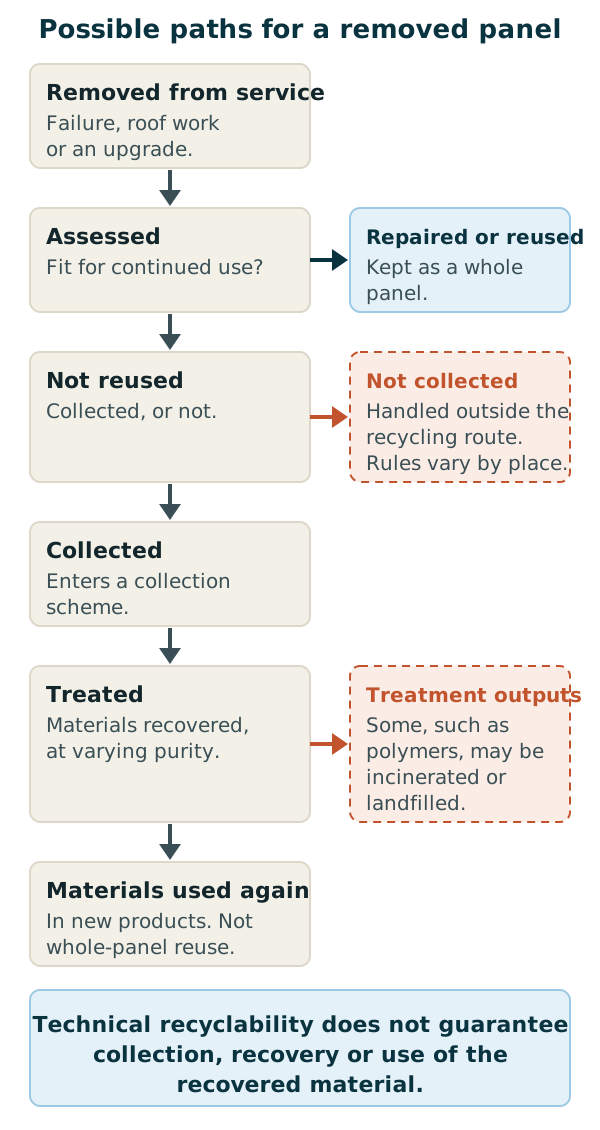
When a solar panel is retired, it can be reused, repaired, recycled or discarded, and which of these happens depends heavily on where the panel is and what it is made of. Some commercial plants recover most of a panel's weight. But a panel being technically recyclable does not mean it will be collected, and a high recovery figure does not always mean the valuable materials are recovered or used again.
This article follows a panel from the day it comes off the roof through the paths it might take. It is about the end of a panel's life, not how panels perform while they are working.
Panels can leave the roof while still working
Not every panel stays until it fails. In interviews on repowering, NREL researchers heard that residential and commercial systems are replaced because of roof work, remodels or demolition, equipment problems such as inverter failure, or a wish to fit newer, better-performing panels on a limited roof area. For large solar farms, interviewees had seen panels replaced only after failures, and otherwise said it "hasn't yet made sense" economically (NREL, 2024, observations from interviews, not a survey).
This matters because a working panel can have a second life. An IEA-PVPS analysis of one common panel type found that keeping a panel for its full 30-year life was better for the environment than replacing it early with a more efficient one. It also found reuse could compete financially for relatively young panels, up to about 10 years old with few or no defects, in large ground-mounted systems, but not for homes, where roof area is limited and remaining lifetime short. It left out testing and recertification costs, which the authors say could decide the question, and called the work preliminary (IEA-PVPS Task 12, 2021).
Reuse also complicates the statistics. PV Cycle, which collects end-of-life panels in Europe, says that more and more panels are being removed while still working, and that many are resold or reinstalled elsewhere, or shipped illegally outside Europe, without passing through official collection systems. It says collection figures are therefore no longer fully representative of how many panels leave the market (PV Cycle, 2025).
How much waste, and when?
Forecasts of panel waste are scenarios, not predictions, and they depend heavily on assumed lifetimes and replacement patterns. The first global projection, a 2016 IRENA and IEA-PVPS study, assumed a 30-year average life and a rapid rise in installed capacity. Its two scenarios gave about 1.7 million tonnes of cumulative waste by 2030 and 60 million tonnes by 2050 if panels fail on a normal schedule, or about 8 million and 78 million tonnes if more fail early. The authors called the results order-of-magnitude, and the study did not model repowering (IRENA and IEA-PVPS, 2016, pp. 29–34). These are historical scenarios, not a current forecast.
A later model of crystalline silicon panels in the United States assumed longer lifetimes and reported lower projected waste by 2050 than the 2016 approaches (Ovaitt et al., 2022; see the table below). The two are not directly comparable, but together they show how much the answer depends on how long panels are assumed to last.
Timing matters as much as volume. PV Cycle notes that Europe and the UK went from about 50 GW installed at the end of 2011 to 427 GW at the end of 2025, so most of the installed base there is still young and waste is arriving slowly.
What is in a panel, and what comes back?
Most of a panel's weight is glass. The 2016 study reported crystalline silicon panels as about three-quarters glass, with polymers, aluminium, silicon, copper and small amounts of silver and other metals, and thin-film cadmium telluride panels as almost entirely glass and polymer, with a very thin semiconductor layer (IRENA and IEA-PVPS, 2016, pp. 41–42).
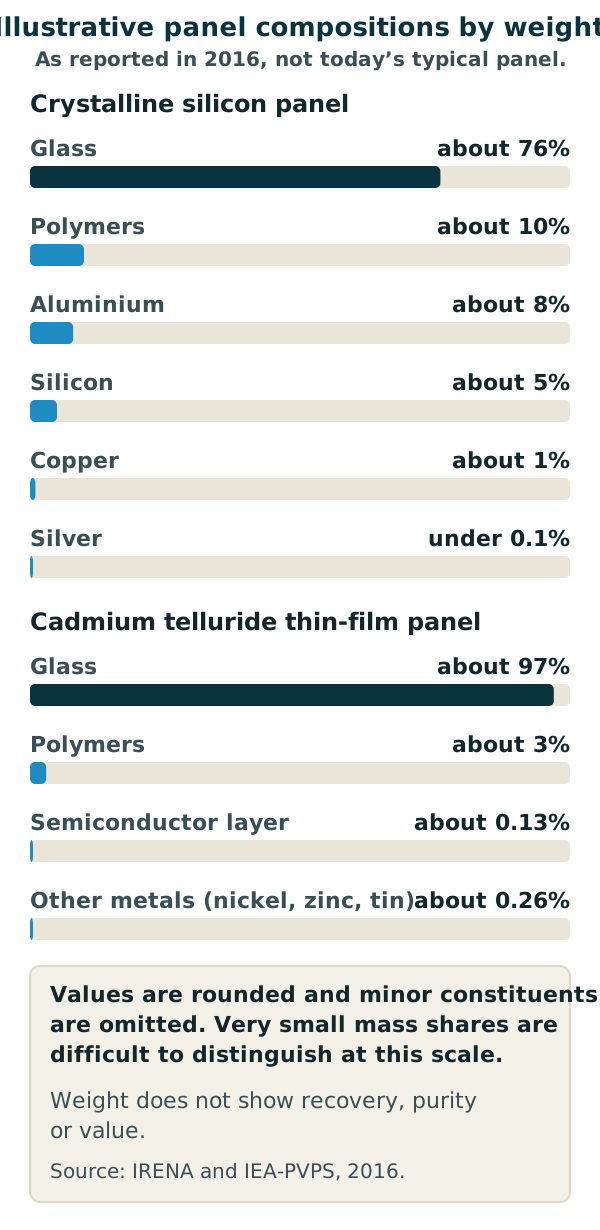
That is why the headline number needs a denominator. A recovery figure by weight can be dominated by glass, aluminium and copper. The same 2016 study reported these could be recovered from silicon panels at cumulative yields above 85% of panel mass, and noted that the silicon, silver and other metals complicate recycling. A figure by weight does not tell you whether the silicon or silver is recovered, or at what purity. For that reason this article avoids a single "percent recyclable" number.
The evidence also mixes very different kinds of operation. A 2026 IEA-PVPS update gathered data from recyclers in the United States and Europe: 13 were invited, and four plus a research consortium responded, so it is a snapshot rather than a survey of the industry (IEA-PVPS Task 12, 2026, executive summary). It describes:
- Operating commercial plants. Mechanical recyclers of silicon panels in the United States, and First Solar's recycling of its cadmium telluride panels. The report says First Solar recovers about 90% of material by weight and has done so since 2005. The report attributes that figure to First Solar, and its executive summary does not describe it as independently measured.
- Pilot and demonstration lines. A research consortium's lines in Germany reported recovering silicon at high purity, and an Italian pilot reported recovering both silicon and silver.
These are recycler-reported results, and the report itself says that material recovery comparisons are complex, so commercial and pilot figures should not be compared directly.
Recovered material is not always reused. The report notes that some outputs, such as polymers, may be incinerated or landfilled, and that what happens to outputs was not consistently reported. In research terms, the authors of one review of silicon panel recycling suggest that recovering high-value silicon is more advantageous than recovering intact wafers, but that this needs purification processes to be designed (Heath et al., 2020, abstract only).
Are panels actually collected and recycled?
This depends on the rules where you live, and rules are changing, so these are examples rather than a global picture. In 2016 the IRENA study found the European Union was the only region with panel-specific waste rules, and that most countries treated panels as general or industrial waste. That is historical context, not a current survey.
European Union. Photovoltaic panels have been covered by the Waste Electrical and Electronic Equipment (WEEE) Directive, 2012/19/EU, since 2012. Directive (EU) 2024/884 amended its financing and marking provisions for panels placed on the market from 13 August 2012, and Member States were due to apply it by 9 October 2025 (Directive (EU) 2024/884, Articles 1 and 2). The framework sets targets for collection and separate targets for treatment, and these are targets, not measured results. We found no verified figure for how much panel waste in the EU is actually collected and recycled.
Washington State, United States. A 2017 law requires manufacturers to offer take-back and recycling for panels bought after 1 July 2017. The state's Department of Ecology says it has delayed the date by which manufacturers need an approved plan from 2025 to 31 January 2031 while fixes to the law are developed (Washington Department of Ecology, read November 2026). We did not verify rules at the US national level.
Australia. Sustainability Victoria says there is no mandatory product stewardship scheme for solar panels, that a national approach is being developed, and that in Victoria this type of waste is treated as e-waste and banned from landfill (Sustainability Victoria, read November 2026). Other states and territories may differ.
Questions worth asking
- When might my panels come off? Is the real driver age, damage, roof work, an inverter fault or a wish for newer panels?
- Can they be reused? Are the panels in good condition, and is there a local market that tests and certifies second-hand panels?
- Who is responsible? Does the installer, retailer or manufacturer have a take-back arrangement, and is it in writing?
- Who takes the panels, where do they go, and what is recovered? Ask for the carrier and the facility, the type of process, and whether recovery is stated by weight or by material.
- How is it documented? Ask what paperwork you receive afterwards, such as a record of collection, delivery to the facility and the treatment outcome, and whether it is in writing.
- What do local rules say? Waste rules for panels vary by country and state, and can change.
- What type of panel is it? Silicon and thin-film panels have different materials and recycling routes.
Studies at a glance
This is a review of selected sources, not a complete survey. Page numbers follow each source's own pagination as we read it.
| Source | Type and place | What it provides | Where the figures are | Notes that affect interpretation |
|---|---|---|---|---|
| IRENA and IEA-PVPS, 2016 | Global waste projection | Waste scenarios, composition, recycling yields, EU context | Table 6 pp. 33–34; Table 5 and Box 3 pp. 29–31; pp. 14, 41–45 | Dated 2016; order-of-magnitude; excludes repowering; composition baseline year not stated; the last part of the report was not read |
| IEA-PVPS Task 12, 2026 | Recycler survey, mainly US and EU | Processes, scale, recovery claims | Executive summary, Table 1 and key findings | Recycler-reported; 4 of 13 invited recyclers plus a consortium; executive summary only |
| Directive 2012/19/EU | EU law, adopted 2012 text | Framework: scope, collection and treatment targets | Articles 7, 11; Annex V | Original text, used only for the general framework; targets not quoted because the current consolidated text could not be retrieved |
| Directive (EU) 2024/884 | EU amending directive, 2024 | Financing and marking rules for panels; review clause | Articles 1 and 2 | Read through the Official Journal text; transposition date 9 October 2025 |
| PV Cycle, 2025 | Collection scheme annual report, Europe | Limits of collection statistics; installed capacity | Operations report, section 02 | Scheme operator's own report |
| IEA-PVPS Task 12, 2021 | Modelling study | Reuse versus early replacement | Executive summary pp. 1–2 | Preliminary; multi-crystalline silicon only; recertification costs excluded |
| NREL, 2024 | Interviews; slide deck | Why systems are replaced early | Observations slides | Interview observations; sample size not stated; US focus; slides, not a paper; no ageing figures used |
| Ovaitt et al., 2022 | Modelling study, US focus | Alternative waste projection | Conclusions p. 20; model setup pp. 14–18 | Reports 2–3.5 times lower cumulative waste by 2050 than the 2016 early-loss and regular-loss approaches rebuilt in the same model on US scenarios; crystalline silicon only; not like-for-like, and not comparable with the 2016 global totals |
| Heath et al., 2020 | Review, silicon panels | Research priorities | Abstract | Abstract only; no numbers used |
| Washington Ecology | Regulator web page | Take-back law and delay | Page text, read November 2026 | Page shows no date; check for changes |
| Sustainability Victoria | Regulator web page | Australian stewardship status | Page text, read November 2026 | Page shows no date; check for changes |
About this article
Circular Abundance wrote this from the sources linked above, reading each in full where we could and checking our own text against them in a separate pass. We have not tested anything ourselves. Some sources were available only in part, and we retained claims only where we could check the relevant sections. Policies and market conditions change quickly, so check current local rules before acting.