
What is embodied carbon, and which building choices can reduce it?
Embodied carbon is the emissions associated with a building's materials and construction. What it covers, and what reuse, design and timber choices change.
Embodied carbon is the greenhouse gas emissions associated with a building's materials and construction: making and moving the materials, the building work itself, and later maintenance, replacement and demolition. The choices that can reduce it are mostly made early: whether to build new at all, how much material a design needs, and which versions of materials are used. Which choice cuts the most depends on the building, and the evidence is firmer for some choices than for others.
This article explains what is counted, then spends most of its length on the choices and on how to test a "lower-carbon" claim. It is about buildings, not roads, bridges or other infrastructure.
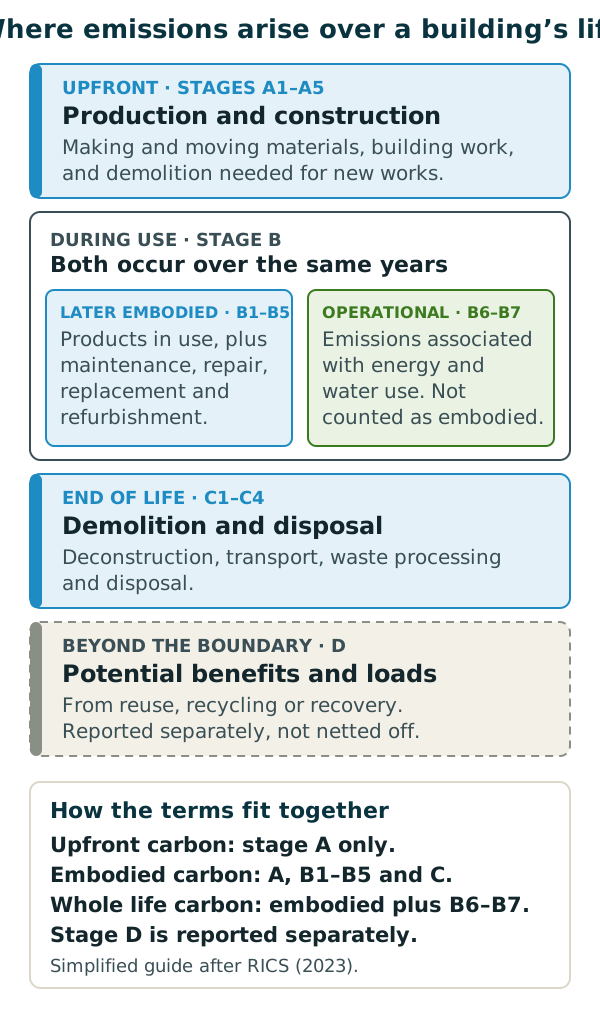
What is counted, and what is not
Terms are used loosely, so it helps to fix them. The RICS whole life carbon standard, a global methodology from the professional body for surveyors, defines embodied carbon as the "total GHG emissions and removals associated with materials and construction processes". That covers production and construction, the impacts that arise during use (including maintenance, repair, replacement and refurbishment), and end of life. Upfront carbon is the part released up to practical completion. Operational carbon is the emissions associated with the energy and water the building uses once occupied, and whole life carbon is embodied plus operational (RICS, 2023, definitions table and section 2.1).
Later embodied impacts and operational emissions happen over the same years of use, not one after the other. Potential benefits and loads beyond the boundary, such as from reusing or recycling materials later, are reported separately from the main stages, outside the embodied carbon total. Results also depend on the study period: the RICS standard sets a reference study period of 60 years for buildings, so a figure quoted without a period, or with a different one, is not like for like.
How big is the share?
At global scale, UNEP and the Global Alliance for Buildings and Construction estimated for 2021 about 10 billion tonnes of CO2 from building operations and about 3.6 billion tonnes from producing building materials such as concrete, steel, aluminium, glass and bricks (GlobalABC and UNEP, 2022). The second figure is an estimate covering materials production, given in the same passage as the 2021 total, and the report does not say whether transport or on-site construction are included. Other sources give different global percentages with different years, boundaries and gases, so they should not be combined with this one.
For a single building, a review of building studies by Röck and colleagues, covering residential buildings and offices mostly in Europe, reported embodied emissions at around 20–25% of life cycle emissions for buildings built to the operational energy standards of the studies' time, 45–50% for highly energy-efficient buildings, and above 90% in extreme cases (Röck et al., 2020, abstract). These are historical categories from studies compiled up to 2019, not today's building rules or benchmarks for a new building.
A share is a proportion. If a building's heating and power emissions fall while its materials stay the same, the embodied share goes up even though the embodied emissions have not changed. So a rising share does not by itself show that embodied emissions are growing, and it does not show how large they are.
Which choices can reduce it?
Reuse and adaptation: assess it first
Keeping an existing building and upgrading it avoids the production and demolition emissions of a replacement, although the upgrade has emissions of its own. The evidence is positive but not one-sided. A systematic review of 251 case studies in 19 countries found that most refurbished buildings had lower life cycle carbon than most new ones, but some new buildings did better, and the authors concluded the evidence could not settle which option is preferable (Schwartz et al., 2018).
There is a further limit. That review compares different buildings, in different places and with different energy supplies. A difference between the two groups does not necessarily show what would happen if the same building were kept or replaced. For that, you need an assessment of the actual building with the same function under each option. Compare:
- What each option delivers. The same floor area and use, not a larger or smaller building.
- How long each is assumed to last. A retained building and a new one may have different remaining or assumed lives, and the study period affects the result.
- What work is needed. Structural repair, new services and a better envelope all carry emissions of their own, as does demolition for a replacement.
- Expected operational performance of both options. That means the proposed retrofit as well as the new building, not an assumption about either.
A German case study applied this kind of comparison to one 1962 multi-family house. Over 50 years after refurbishment, its modelled life cycle greenhouse gas emissions (fossil global warming potential) were lowest for an energetic refurbishment, with a timber replacement building close behind, a mineral replacement somewhat higher, and continuing use without upgrades far higher. The authors state that the results are limited to that context and cannot be extrapolated to all buildings. They did not assess cost, other environmental indicators or future changes to the energy supply (Storck et al., 2023, sections 3–5).
Using less material
Design decisions can change how much material a building needs while meeting the same structural requirements. A study of 23 steel-framed buildings from three UK design consultancies calculated a utilisation ratio for each beam: the load in the building's design calculations divided by the most its section is allowed to carry under the design standard, taking the highest result across several checks, including bending, shear and deflection. Averaged across beams and weighted by mass, so that heavier beams count for more, the ratio was 0.54. That is a calculated design figure, not a measurement of real loading, and it is not a percentage of steel that can simply be removed: steel comes in discrete section sizes, and other requirements such as floor vibration, which the authors did not analyse, sometimes governed. They identify the main cause as designers adding material to cut labour and procurement costs, for example by repeating section sizes. They did not establish the cost trade-offs, and the sample was UK-only and chosen to be typical (Moynihan and Allwood, 2014, sections 3–5). The practical point is not a saving figure. It is that how a structure is designed can matter as much as which material is chosen, and that it is fair to ask what each part of a design is doing.
Lower-carbon versions of the same material
Concrete shows both the opportunity and the need for care. A modelling study of 512 virtual mixes found that, for the same strength, embodied emissions varied by a factor of about three between mix designs. The authors stress that the absolute values should not be taken as a definitive guide, and the study held strength constant but did not examine durability or curing (Purnell and Black, 2012). So "lower-carbon concrete" is a claim to test against what each use needs, including strength, durability and construction requirements, not an automatic substitution. A UNEP and Yale report groups the wider options as avoiding unnecessary extraction and production, shifting to regenerative materials, and decarbonising conventional ones such as cement, steel and aluminium (UNEP and Yale Center for Ecosystems + Architecture, 2023). We do not quote percentage savings, because they depend on the product, the place and the design.
What to ask for when someone says "lower carbon"
- The same function in both options. The same strength, performance and durability requirements and the same assumed service life, not just the same weight or volume of material.
- The same boundaries and study period. The RICS standard says any partial assessment used to compare options early on should use the same reporting boundaries as a full assessment, so that the comparison is transparent and consistent, and it requires its 60-year period, with other periods reported only in addition.
- Whole-life coverage. Whether later replacement and operational emissions are included, or only the upfront stage. A lower upfront figure can be outweighed later, and the standard cautions against assuming a material is better without assessing it.
- The data behind it. Whether figures are generic or specific to the product to be installed. Early assessments can use generic data, and environmental product declarations for construction products follow the EN 15804 standard.
- Assumptions in writing. Service lives, replacement cycles and any departures from the standard's method, which it says must be justified and recorded.
- A prediction, not a measurement. The standard notes that these calculations are predictions until measured data are available.
(RICS, 2023, sections 1.2, 1.4.5, 1.5, 1.7, 2.3, 2.4 and 4.2.)
Timber: stored carbon is not the same as net climate effect
Wood contains carbon that trees took from the air, so timber is often described as storing carbon. Whether using it lowers a building's climate impact is a separate question, and it depends on how the carbon is counted.
The RICS standard says biogenic carbon, the carbon taken up by growing plants, must be reported separately when reporting only upfront carbon, and should be included in the total when reporting embodied or whole life carbon (RICS, 2023, glossary and section 2.1).
A comparison of four accounting approaches on one multi-storey timber building in Austria shows why this matters. Two static methods either treat uptake and release as cancelling out, or credit the uptake at production and charge the release at end of life. Two dynamic methods model forest regrowth over a 100-year rotation. The methods gave noticeably different results, and the study warns that crediting stored carbon at the production stage alone can give misleadingly negative scores. In that study the timber was assumed to be burned for energy at end of life, and the authors note that regrowth offset only a modest part of the building's total score (Hoxha et al., 2020, sections 2.2, 3.3 and 5).
So the practical reading is conditional. The net effect of choosing timber depends on how long the building lasts, what happens to the wood at the end, how long the forest takes to regrow, and which accounting method is used. The study covered one building and one forest type.
Studies at a glance
This is a review of selected sources, not a complete survey. Section and page numbers follow each source's own numbering as we read it.
| Source | Type and place | What it provides | Where the figures are | Notes that affect interpretation |
|---|---|---|---|---|
| RICS, 2023 | Professional standard, global method | Definitions, life-cycle stages, reporting and comparison rules | Definitions table; sections 1.2–1.7, 2.1–2.4, 4.2 | Numerical assumptions are UK-based; sections on product data and verification, and the biogenic appendix, not read |
| GlobalABC and UNEP, 2022 | International assessment, global | 2021 global estimates | Executive summary | Executive summary only; embodied figure covers materials production |
| Röck et al., 2020 | Peer-reviewed review of life cycle studies | Embodied share by building efficiency class | Abstract; sections 2.2, 3.1 | Residential and office only; mostly European; historical classes; mixed methods |
| Schwartz et al., 2018 | Systematic review, 19 countries | Refurbished versus new buildings | Abstract; results | Compares different buildings; mixed scopes; authors call for a common protocol |
| Storck et al., 2023 | Single case study, Germany | Reuse versus replacement for one building | Sections 2.3, 3.3, 5 | One building; fossil global warming potential only; static energy mix; no cost |
| Moynihan and Allwood, 2014 | Peer-reviewed study, UK | Utilisation of structural steel | Sections 3–5 | 23 UK buildings; some criteria not analysed; cost trade-offs not established |
| Purnell and Black, 2012 | Peer-reviewed modelling study | Embodied CO2 of concrete mixes | Sections on method and results | Virtual mixes; values not definitive; durability not examined |
| UNEP and Yale, 2023 | Guidance report | Three strategies for materials | Web page | Web page only; no measured figures used |
| Hoxha et al., 2020 | Peer-reviewed case study, Austria | Four biogenic carbon methods compared | Sections 2.2, 3.3, 5 | One timber building; no percentages quoted |
About this article
Circular Abundance wrote this from the sources linked above, reading each in full where we could and checking our own text against them in a separate pass. We have not tested anything ourselves. Some sources were available only in part, and we retained claims only where we could check the relevant sections. Methods and standards change, so check current local requirements before acting.